Cracking Group Discussions and Personal Interviews: A Complete Starter Guide
SSIM Hyderabad
Author
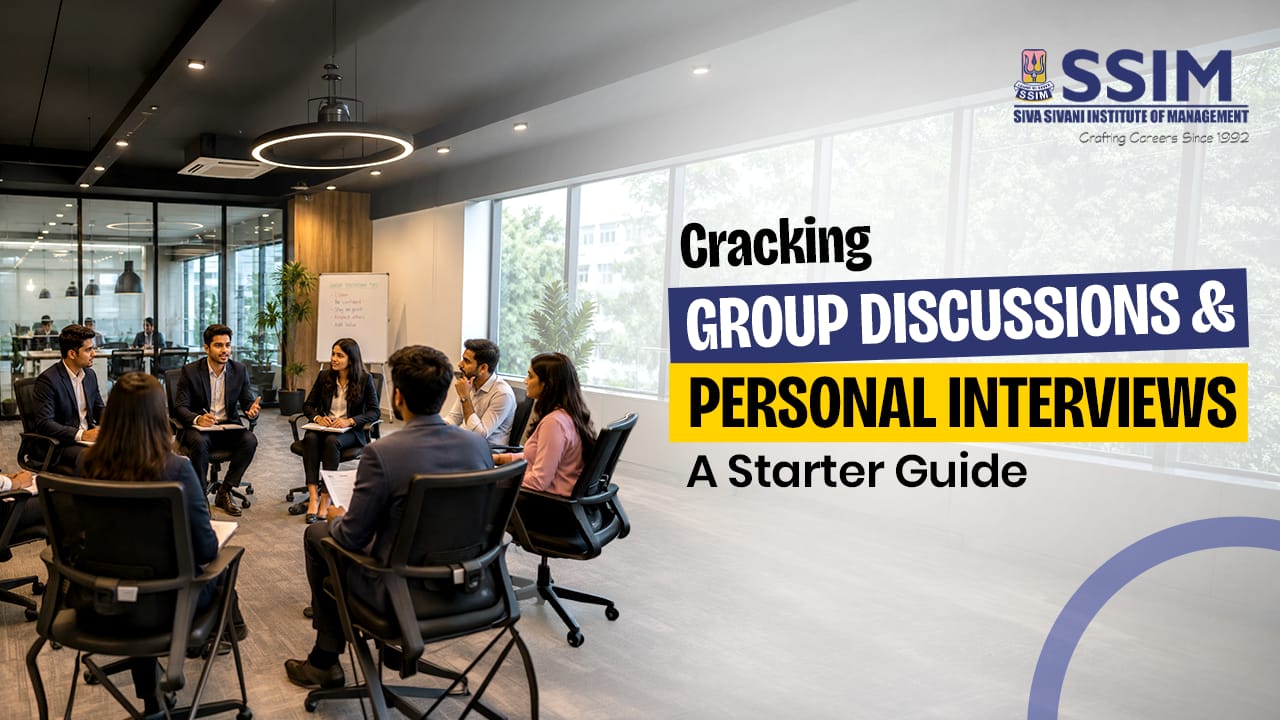
A strong entrance exam performance opens the door, but the next stage determines whether you walk through it. The final selection process at AICTE-approved PGDM colleges in Hyderabad often depends on how effectively you perform in the group discussion (GD) and personal interview (PI) rounds.
These assessments go beyond academic scores to evaluate your communication skills, analytical thinking, confidence, leadership potential, and overall suitability for a management programme. Yet, many aspirants begin preparing only after receiving an interview call, leaving little time to build these essential skills.
This starter guide explains what admission panels look for and how you can approach each stage with confidence and clarity.
PGDM 2026–28 · Admissions Open
Shape your management career at SSIM
Why Do B-Schools Conduct Group Discussions?
Written tests measure aptitude. They don’t measure how you think on your feet, how you handle disagreement, or whether you can lead a room without dominating it. That’s exactly what GDs and PIs are designed to reveal.
Most AICTE-approved PGDM colleges in Hyderabad use these rounds to evaluate:
- Communication ability is assessed through how clearly, confidently, and concisely you express your ideas.
- Analytical thinking is evaluated based on your ability to analyse a topic logically and present well-reasoned viewpoints.
- Leadership potential is reflected in how effectively you guide a discussion while encouraging others to contribute.
- Team compatibility is demonstrated through your willingness to collaborate, respect different perspectives, and work well with diverse peers.
- Self-awareness is judged by how well you understand your strengths, areas for improvement, and long-term career goals.
In short, these rounds aren’t obstacles. They’re a preview of what your MBA classroom will actually feel like: fast-paced, opinion-driven, and collaborative.
What Exactly Are Evaluators Looking For?
In a Group Discussion
- Content knowledge: Do you understand the topic, or are you just repeating buzzwords?
- Initiation and closure: Starting or summarising a GD well earns serious points — but only if done thoughtfully.
- Listening skills: Are you building on what others say, or just waiting for your turn to talk?
- Body language: Confident posture, eye contact, and calm gestures speak louder than words.
- Behaviour under pressure: Do you stay composed when the discussion gets heated?
In a Personal Interview
- Clarity of purpose: Why an MBA? Why this college? Why now? These aren’t trick questions; they test self-awareness.
- Depth over breadth: Panels often dig into two or three topics deeply rather than skimming many.
- Honesty: Bluffing is easy to spot and even easier to penalise.
- Composure: How you handle a tough or unexpected question often matters more than the answer itself.
Whether you’re attending your first GD or preparing for a personal interview, a structured preparation plan can significantly improve your performance. Let’s look at the strategies that actually work.
Preparation Strategies That Actually Work
1. Build a Strong Current Affairs Base
Read newspapers, business magazines, and credible news apps daily not just headlines, but the “why” behind major events. Focus on business, economy, and social issues, since these dominate most GD topics.
2. Practice Structured Thinking
Before speaking, mentally organise your points using simple frameworks, for example, causes, effects, and possible solutions. Structured answers always sound more credible than rambling ones.
3. Mock GDs and Mock Interviews Are Non-Negotiable
Reading about GDs won’t prepare you for the adrenaline of an actual one. Join peer groups, coaching sessions, or campus prep clubs to simulate the real experience. Many AICTE-approved PGDM colleges in Hyderabad also conduct pre-admission orientation sessions. Attend these if offered, as they often mirror the actual selection format.
4. Prepare Your Own Story
Your resume, academic background, and career goals should form a consistent narrative. Interviewers can tell when answers feel rehearsed versus genuinely reflective, so know your own story inside out.
5. Research the Institute
Know the college’s specialisations, faculty strengths, placement record, and pedagogy. When asked, “Why this college?” a generic answer stands out, for all the wrong reasons.
Common Mistakes Candidates Make
- Talking too much or too little: Both extremes hurt you. Aim for meaningful contributions, not airtime.
- Interrupting others: It signals poor teamwork, not confidence.
- Memorised answers: Panels ask follow-up questions specifically to catch scripted responses.
- Ignoring body language: Slouching, fidgeting, or avoiding eye contact undercuts even a great verbal answer.
- Being overly aggressive in GDs: Assertiveness is good; aggression is not.
- Not having questions of your own: Most interviews end with “Any questions for us?” A blank response is a missed opportunity.
Body Language Tips That Make a Difference
Your words matter, but so does everything around them.
- Sit upright and stand confidently — it conveys confidence without saying a word.
- Maintain natural eye contact with the group in a GD and with the panel in a PI.
- Use open gestures — avoid crossed arms or clenched fists.
- Nod to acknowledge others — it shows active listening.
- Control nervous habits — tapping pens, shaking legs, or touching your face can be distracting.
Small adjustments here often make a bigger impression than an extra fact you memorised.
Communication Skills Worth Sharpening
- Speak clearly and at a moderate pace — nervous speed-talking reduces clarity.
- Use simple, precise language — clarity beats complexity every time.
- Practice summarising — being able to condense a discussion into two lines is a valuable skill that panels notice.
- Work on your listening — good communicators respond to what’s actually said, not what they assumed would be asked.
Building Confidence Before the Big Day
Confidence isn’t something you’re born with; it’s built through preparation and repetition.
- Simulate real conditions: Practice in formal attire, with a timer, and in front of others.
- Reflect after every mock session: Note what worked and what didn’t.
- Focus on progress, not perfection: Each mock round should feel a little smoother than the last.
- Manage pre-interview anxiety: Simple breathing exercises before entering the room can calm nerves significantly.
- Remember: rejection isn’t the end; many successful managers faced multiple rejections before their final selection.
Final Thoughts
Clearing the GD and PI rounds is less about giving perfect answers and more about demonstrating confidence, clarity, and the ability to think on your feet. If you’re aiming for admission to AICTE-approved PGDM colleges in Hyderabad, start preparing early, stay authentic, and treat every practice session as a step towards success. The skills you build today will benefit you well beyond the admission process.
FAQS
1. What do admission panels evaluate during a group discussion and personal interview?
Admission panels assess communication skills, analytical thinking, leadership potential, confidence, problem-solving ability, and your overall suitability for a management programme.
2. How should I prepare for a PGDM personal interview?
Start by reviewing your academic background, understanding your career goals, staying updated on current affairs, and practising common interview questions through mock interviews.
3. What should I do if I’m unfamiliar with the GD topic?
Stay calm, listen carefully to the discussion, identify key arguments, and contribute a logical point backed by examples or reasoning. Thoughtful participation is more valuable than speaking the most.
4. Are Group Discussions and Personal Interviews compulsory for admission to AICTE-approved PGDM colleges in Hyderabad?
Most AICTE-approved PGDM colleges in Hyderabad include GD and/or PI rounds as part of their admission process to evaluate candidates beyond entrance exam scores. However, the exact selection process may vary from one institute to another.
5. How can I improve my chances of clearing the GD and PI rounds?
Consistent practice, strong communication skills, awareness of current affairs, confidence, and a clear understanding of your career aspirations can significantly improve your performance during the selection process.
